

The Calendar Has Been Trying to Tell You SomethingMost people think of January as the month for gym memberships and half-hearted resolutions.
And April?
That’s just tax panic season, right?
Scrambling for receipts, forwarding salary slips, texting your CA at odd hours hoping for a miracle.
But here’s what nobody really sits down to explain. These two months, sitting at opposite ends of the Indian financial year, are the two most powerful checkpoints you have.
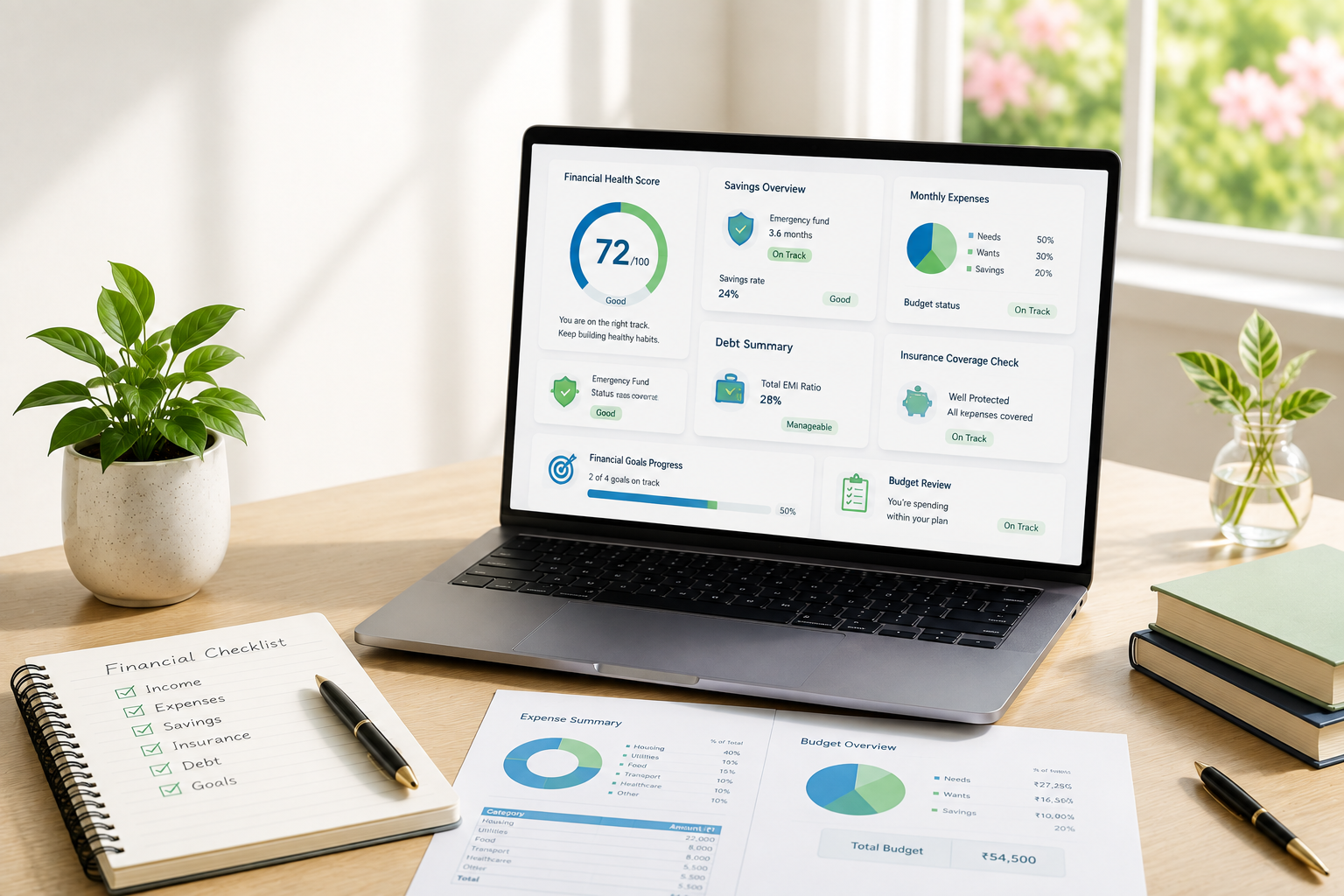
If you genuinely want to check your financial health with any kind of intention and structure, January and April are the months where that work makes the most impact.
Not randomly in August. Not because you read a blog at 2 AM. These two months, specifically, for real reasons.
Why January Feels Like a Reset Button
Now, here’s the thing about January. It carries this psychological energy that nothing else really matches.
The calendar flips, people feel reflective, and there’s this brief window before routine fully swallows everyone again, where you have mental space to think clearly.
That’s rare.
And in India, January also lands right at the three-quarter mark of the financial year, which means you still have a full quarter left to course correct before the books close in March.
Think about what that means practically.
If your SIPs have been running on autopilot and you haven’t looked at them since you set them up sometime last year, January is your window to check your financial health before the year closes out.
If your insurance premiums are due in the next few months and you’ve been vaguely meaning to review whether your coverage still makes sense for your life situation, January is that moment.
The year hasn’t ended.
The financial year hasn’t ended. You still have time to actually do something with the information you uncover rather than just feeling bad about it in hindsight.
The Quiet Urgency of the Third Quarter Mark
There’s a difference between reviewing your finances when it’s already over and reviewing them when you can still act.
January sits in that second category. You’ve had nine months of the financial year behind you, which means your spending patterns are clear, your savings rate is visible, and your investment performance is measurable.
You’re not guessing anymore. You have actual data.
And if something looks off, you have three months to fix it. Three months to top up an ELSS if your tax-saving investments are short. Three months to redirect surplus cash that’s been sitting idle.
Three months to have a conversation with your partner or family about expenses that have quietly crept up. That’s not a small window. Three months done with intention can shift a year’s outcome meaningfully.
What April Changes Completely
Okay, so now we move to April and honestly, this one is even more underrated as a financial moment.
April is the first month of the new Indian financial year. The slate is technically clean.
A fresh set of tax slabs to understand, new financial year targets to set, investment limits that have reset to zero and are waiting to be filled.
April is when the financially organised people in India quietly pull ahead.
Most people in April are recovering from the March madness of the last-minute tax filing and not really thinking clearly yet.
They’re tired.
They’re relieved.
And so, they drift into April without actually setting anything up properly for the next twelve months.
And then somehow December arrives, and they’re doing the exact same scramble all over again. You know the feeling.
The Trap of Drifting into a New Financial Year
Here’s what drifting into April without a plan actually costs you. And I mean this literally, not just philosophically.
If you start your SIPs in April rather than waiting until July because you got around to it, you get three additional months of compounding over a twenty-year period.
That’s real money.
If you review your insurance in April when you’re calm rather than November when renewal notices start landing, you make better decisions.
If you sit down in April and actually map out what you want to save, spend and invest over the next twelve months, you have a framework to come back to when things get noisy.
Which they always do.
April also gives you something January doesn’t. It gives you a completely clean starting point.
No hangover from the previous year’s mistakes, at least not in terms of the tax framework. Just a fresh set of rules, a fresh set of limits, and ideally a fresh set of intentions.
Numbers That Actually Tell a Story
Let me bring this down to ground level for a minute because abstract advice is pretty useless if you can’t connect it to your own life.
In January, the questions worth asking yourself are things like,
How much did I actually save this year versus what I planned?
Where did my money go that I didn’t expect?
Am I paying for subscriptions, memberships or recurring expenses that I forgot about and genuinely don’t use anymore?
Is my emergency fund still adequate given any life changes in the past year, a new baby, a job switch, a health scare?
These aren’t complicated questions. But most people never ask them because there’s no natural prompt in their calendar to do so. January can be that prompt if you treat it that way deliberately.
In April, the questions shift. Now you’re looking forward to it rather than back.
What does the next year need to look like financially?
Have the new tax rules changed anything about how I should structure my investments?
Is this the year I finally sort out a proper term insurance plan instead of vaguely meaning to?
Do I need to increase my SIP amounts because my income has grown, but my investments haven’t kept pace?
The Emotional Side Nobody Mentions
Okay and here’s a slightly personal aside that I think actually matters.
Finances are emotional.
Nobody really admits this, but it’s true.
The reason people avoid looking at their money closely is not that they don’t have the time. It’s because it’s uncomfortable.
Maybe you overspent last year and don’t want to face it. Maybe your savings are lower than you feel they should be at your age, and the comparison is painful. Maybe you just feel lost and a little embarrassed that you don’t fully understand where all your money goes.
January and April are good moments to face all of that precisely because they come with a natural narrative attached.
January is the start of something new.
April is the official financial year beginning.
These frames make it slightly easier to approach discomfort because there’s a story you can tell yourself. This is a checkpoint, not a judgment.
I’m looking at the map so I can navigate better, not so I can feel terrible about where I’ve been.
What a Structured Two-Times-a-Year Review Actually Looks Like
Here’s what I’d suggest, and this is coming from watching a lot of people stumble through this. Don’t make it a massive production.
Don’t block out an entire weekend and promise yourself you’ll build the perfect spreadsheet. That’s how reviews never happen.
Instead, in January, spend two focused hours going through three things. Where your savings landed versus where you intended them to land.
Whether your investment portfolio still reflects what you want it to reflect, given where you are in life. And whether your protection, meaning insurance, is still appropriate.
In April, spend those same two hours doing three different things.
Set your investment targets for the year and automate them if possible. Review any changes in your income or life situation that should change your financial plan.
And look at your tax structure for the new year early, not in February when it’s too late to do much about it.
That’s it.
Four hours a year done at the right moment, with the right questions. Most people never do this. Which is exactly why most people feel perpetually behind with their finances even when they’re earning decent money.
The Compounding Effect of Showing Up Twice a Year
Something worth understanding is that financial habits compound the same way money does. If you properly audit your money situation in April this year and make one good decision based on what you find, that decision plays out over twelve months before you revisit it.
Then in January, you check back in and adjust if needed. Then in April again you set the next year up right. Over five years, ten years, this rhythm of showing up twice a year at the right moments with the right questions becomes genuinely transformative.
Not because any single review was magic. But because the accumulated effect of informed decisions made consistently over time is dramatic.
Before We Land This Plane
Now I want to be honest with you about one last thing.
There’s a version of this advice that sounds simple and actually feels hard.
Because checking your finances honestly requires a willingness to see things that might be uncomfortable.
But here’s what I’ve come to genuinely believe: the discomfort of knowing is always smaller than the cost of not knowing.
Always.
And if you want to check your financial health in a way that actually changes things rather than just making you feel briefly responsible before you forget about it, doing it in January and April gives you the best possible structure to work within.
The One Habit That Changes Everything
So, here’s the final thought worth sitting with.
January and April are not magic months. They don’t fix anything on their own. But they are the two moments in the Indian calendar that align most naturally with reflection, action, and fresh starts.
Build your review rhythm around them. Treat them as appointments you don’t cancel.
And if you’ve never properly taken the time to check your financial health before, this coming January or April, whichever arrives first, is as good starting point as any.
The calendar has been laying this out for you all along. You just had to look at it differently.